Ancestry, adoption, and identity
The Edge of the WorldAncestry, adoption, and identity form a continuing inquiry into what makes a family and how a person can live with more than one account of belonging. Through Shay’s research into his biological relatives, the novel reveals a history he did not know, including Polish, Danish, Lithuanian, and English connections, as well as the losses and separations surrounding his infancy. But the discoveries do not displace the family that raised him. The story’s central movement is from an unexpected genealogical revelation toward a more capacious identity: Shay can acknowledge biological inheritance while remaining a Maloney and sustaining the relationships formed through care.
The Research and Its Stakes
The inquiry begins with a misunderstanding about the subject of a genealogy project. Shay believes the research concerns his adoptive family; Ollie explains that he is investigating Shay himself. The distinction changes the emotional stakes of the work. This is not simply a record of the family Shay already knows, but an attempt to trace the person he was before adoption and the relatives whose names and lives have been absent from his understanding.
The revelation also exposes the limits of the project’s original framing. Shay understands that the studio was interested in him because he was adopted, treating that fact as a way to make history more compelling. He has already signed the contract, but asks to wait before beginning until he has spoken to his father. His request marks a boundary: the research may concern biological origins, but entering that history affects the family relationships he already has. The search therefore begins amid unequal control over information and presentation. A production can regard adoption as an intriguing premise; Shay experiences it as part of his own life, with consequences for the people who raised him.
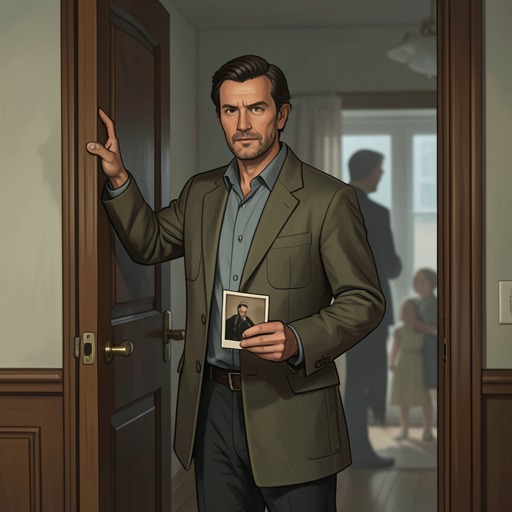
Ollie’s first disclosures reveal how little Shay knows about his birth identity. A photograph of Shay’s great-uncle shows a young man holding a battered cart rattle, whose build and long limbs remind Ollie of Shay. Yet resemblance does not immediately settle identity: the name associated with Shay’s birth differs from the one he has lived under. Ollie feels guilty for having assumed that Shay already knew these facts. The episode frames genealogical knowledge as more than the recovery of names. A family resemblance can make a stranger feel suddenly near, while the unfamiliar name attached to that resemblance makes clear that recognition and knowledge are not the same thing.
Inherited Histories and Cultural Lineage
As the investigation proceeds, the family tree complicates any single account of Shay’s background. He learns that the Danish ancestry comes through his maternal line, while Anna was Lithuanian. The account of Anna makes inheritance especially indirect: she had a child while married to Shay’s sixth great-grandfather, then left the baby in the capital. That child, Shay’s fifth great-grandmother, was also named Anna. Although the two Annas never saw each other again, descent carried the connection forward. Biological inheritance persists across a break in personal contact, but genealogy cannot restore the relationship that never continued.
The research also identifies Joyce King, née Kaspersen, as Shay’s great-great-grandmother. Joyce belongs to the Danish side of the family: Rudolph was her grandfather, while her mother and husband were English. Ollie describes the Danish element as fading over subsequent generations. The photograph of Joyce gives Shay a more substantial point of contact than a name alone. Looking at it, he describes feeling detached from the unfolding revelation, as though observing it from above. His response conveys the unsettling distance between a fact becoming known and that fact becoming personally integrated. He can see evidence of a family likeness without yet feeling at home in the history it documents.
The stories of Anna and Joyce also resist the idea that ancestry is a neat, uninterrupted inheritance. Marriage, migration, separation, and the passage of generations all shape which connections survive in the record. Anna’s child remained in the family line although mother and daughter did not reunite; Joyce’s Danish ancestry became less prominent through later English connections. In this history, descent supplies links, but it does not guarantee shared memory or a continuous cultural life. Shay’s question about whether Anna’s connection can count when it came through marriage reflects the difficulty of translating a complicated family tree into a personal sense of inheritance.
Adoption, Care, and Missing Years
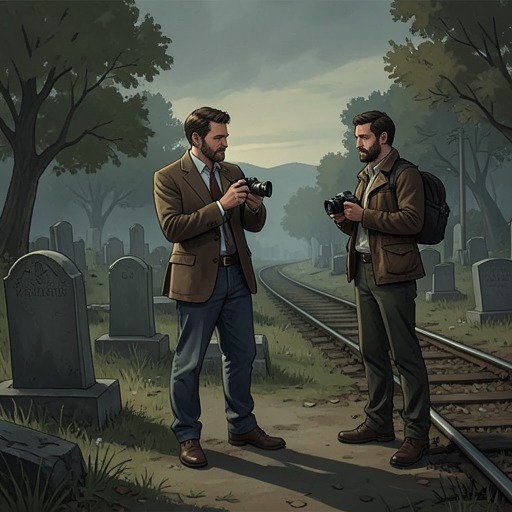
The most consequential gaps in Shay’s history concern not distant ancestors but his own infancy. At his biological father’s grave, he asks about Francesca, his mother, and learns that she had no siblings and that her parents were already dead. She had been an accomplished hockey player, leaving school reports that might offer glimpses of her life. Shay is not ready to look at them immediately. Instead, he wants to know where he was when the fire happened and whether he was present. Ollie has checked an archived report; it contains no mention of a baby, although Shay would have been only a few months old. The available record can narrow a question without resolving it.
The chronology remains incomplete. Shay recalls that he was two when he was adopted and had spent only six months in foster care beforehand, leaving an unexplained interval between Francesca’s death and foster placement. Ollie’s research points to the people who cared for him during part of that history: Artur and Zofia Nowack, his biological grandparents and Rudek’s parents. They looked after Shay after Francesca died and fought to keep him, but social services did not allow them to do so. Ollie suggests that the decision may have had something to do with Rudek, while acknowledging that the reason is uncertain. Shay was taken from his grandparents and placed in foster care; as far as the available research shows, he never saw them again.
Learning that Artur and Zofia wanted him matters independently of the fact that he could not remain with them. Shay asks whether they wanted him, and Ollie confirms that they did. At the willow tree planted in their honour, Shay clings to Ollie; they move to a nearby bench, sit with their knees pressed together, and clasp hands. The camera is absent, but Shay does not ask about it. In this moment, information about past care meets care in the present. The record cannot undo the separation or answer every question about Shay’s early life, but it can establish that the grandparents’ failed effort to keep him was not a failure of attachment.
Family as Daily Practice
Biological descent is only one of the novel’s measures of kinship. Earlier, after Shay has taken insulin and eaten breakfast, Larry sits with him. Shay falls asleep with his head on Larry’s shoulder, despite finding the idea of leaning on anyone unsettling. Corina later comes to take him away. The episode is ordinary and physical in its small scale, but it gives belonging a form different from the family tree: comfort offered, accepted, and repeated within a shared daily life.
Larry also mediates between Ollie and the band’s wider circle when Ollie leaves the bus after conflict with Jumbo. He explains that Jumbo is upset about falling out with his kin, did not mean his earlier remarks, and cares deeply for Shay. Larry adds that the group has long accepted Shay’s bisexuality. This exchange does not resolve every tension between the characters, but it shows how a network of chosen and established relationships can carry reassurance when one person is angry or absent. Kinship appears not as a single category but as care, acceptance, loyalty, and the work of explaining one person to another.
Against these bonds, Shay’s biological relatives do not become automatic substitutes for the people who raised him. By the novel’s later account, he has not sought surviving members of his biological family, at least for now. That choice does not erase his interest in learning what happened or diminish the relatives whose lives he has recovered. It distinguishes knowing a family history from deciding to pursue a relationship with everyone named in it. The distinction is central to the novel’s treatment of adoption: discovery can expand a person’s understanding without dictating whom that person must approach or regard as home.
Naming and an Unfinished Identity
Shay’s response to his newly discovered origins develops through both music and naming. Once he understands the origins of the Polish hurdy-gurdy, he learns to play it quickly. The instrument links a present practice to a history newly made legible, allowing inheritance to be encountered through skill as well as archival research. Yet the connection does not require him to claim a name that feels unavailable to him. He considers Rudzio Maloney as a performer’s moniker, rejects Rudzio Nowack as not his name to use, and explains his position through a refusal to be wholly one identity and none of the other.
That choice gathers the novel’s distinctions into a single, practical decision. Maloney belongs to the life Shay has lived and the people who raised him; Nowack and the recovered Polish history disclose a biological past that is also his, even if he does not adopt the family name as a performing identity. He does not have to turn ancestry into a replacement story in order to take it seriously. The outcome is not a final resolution of every missing year or a reunion with biological relatives. It is a provisional integration: Shay recognizes the force of what he has learned, retains his connection to the Maloneys, and leaves open what he may choose to do with the rest of his family history.